Month: February 2022

African-American Cowboys…Wild Wild West!

African American cowboys
Vector Illustration with 10 EPS of side view of African American man.

African American Cowboys…according to Bennie J. McRae, Jr., in his 1996 book Lest We Forget, “the traditional history of the American West almost totally ignores the role of black cowboys and other pioneers who traversed and settled in the West west of the Mississippi during the nineteenth century.”

McRae said… out of about 35,000 cowboys who worked the ranches and rode the trails, between five and nine thousand were African Americans.

However, the well-known Red River portrays not one black cowboy riding the Goodnight-Loving Trail in the late nineteenth century.

It is estimated that one in four cowboys in the Wild Wild West were black, so why aren’t black cowboys more prevalent in popular culture?

 Many Black pioneers crossed the vast territory west of the Mississippi in the nineteenth century and settled there,” 

Moreover, McRae said: 

“History books and Hollywood successfully erased blacks from the historical record of the West.”

Trailblazers of sorts, they were…

Here are some historic Black cowboys who helped shape the Old West. 

Nat Love… Born in June 1854 

“I eventually brought up at Dodge City, Kansas, which at that time was a typical frontier city, with a great many saloons, dance halls, and gambling houses, and tiny of anything else.” – The Life and Adventures of Nat Love.

In his 1907 autobiography,

Black cowboy Nat Love recounts tales about his life on the frontier that read like scenes from a Lonesome Dove film.

Little-known facts, 

 Nat Love described Dodge City, Kansas, as a town strewn with the romanticized institutions of the frontier: ” many saloons, dance halls, and gambling houses, but not much else.” 

He moved enormous cattle from one pasture to another, drank with Billy the Kid, and engaged in shootouts on the trails with Native Americans defending their land.

 When he wasn’t fighting Indians, he engaged in activities such as “dare-devil riding, roping, shooting, and such.”

A trailblazing, sharpshooting, horseback riding cowboy embodies the spirit of the American West better than any other image. 

 “Deadwood Dick.”

During these years as an Arizona cowboy, Nat was referred to as Red River Dick and claimed to have met many famous men of the West, including Pat GarrettBat Masterson, and Billy the Kid.

Further reading: The Life and Adventures of Nat Love Better Known in the Cattle Country as “Deadwood Dick,” by Himself (University of North Carolina at Chapel Hill)

Bill Pickett (1870-1932), African American Cowboy

  • Successful showman and cowboy
  • Invented the art of “bulldogging.”

 Besides being a cowboy, Bill Pickett was also a performer. He showed tremendous skill with horses and achieved fame for a technique he developed for steer wrestling, called “bulldogging.”

 Growing Up

Bill Pickett’s actual birth year is uncertain, but he was the second of 13 children born to Thomas Jefferson Pickett, a formerly enslaved person, and Mary “Janie” Gilbert. 

The family’s ancestry was African, white, and Cherokee.

The family lived in an area of Texas known as Jenks Branch Community. 

A family named Miller, who opened the land for other African Americans to come after the Civil War, settled the land.

Legend has it that Bill Pickett was 5’7″ and weighed 145 pounds. He must have been all muscle.

Ranch Life

In 1890, Pickett married Maggie Turner, a formerly enslaved person and daughter of a white southern plantation owner. The couple had nine children.

By 1888, Pickett and his brothers started their horse-breaking and cowboy services company in Taylor, Texas. 

The company was known as the Pickett Brothers Bronco Busters and Rough Riders Association. Their advertisements promised: “Catch and taming wild cattle is a specialty.”

Invented the Art of Bulldogging

 Pickett developed the bulldogging method because bulldogs were sometimes used to help stop a runaway steer.

Pickett decided that if a bulldog could bring down a steer, so could he. He practiced riding after a steer, springing from his horse, and wrestling the steer to the ground. 

He then bit and held the steer’s lip himself until the steer had still. He became known as the “bulldogger.”

Pickett gave exhibitions in Texas and throughout the West, usually riding his horse Spradley. 

  • In 1905, he signed on with the 101 Ranch Show (similar to Buffalo Bill’s Wild West Show.
  •  In 1907, he joined the 101 Ranch full-time.

While African-American cowboys aren’t featured in the popular narrative, historians estimate that one in four cowboys were black. 
A Time To Reflect…BLACK HISTORY MONTH!

a time to reflect
Vector Illustration

A time to reflect is Black History Month on what has been accomplished. Still, it is also a time to recognize the challenges that remain. 

African Americans have made significant contributions of science and technology to politics, sports, and history. 

The following are outstanding black Americans who have helped shape our country and world.

Matthew Henson: Arctic Explorer

Matthew Henson was born in Maryland just after the Civil War and had a hard-luck childhood. 

At age 11, Henson lived with an uncle in Washington, D.C., after the death of his parents.

 He traveled by foot to Baltimore, where he hoped to work on a ship. He succeeded, and he became a cabin boy on a freighter.

 After six years of sailing the ocean, Henson returned to Washington and took a store clerk in a furrier’s shop.

And then…

Henson met Navy lieutenant Robert Edwin Peary at the store. Subsequently, Peary offered him a job as his assistant on a trip to Nicaragua. 

Henson soon became a permanent member of Peary’s crew.

 When Peary announced plans to reach the top of Greenland in 1891, he invited Henson along for the journey

Throughout the 1890s, 

Peary and his team returned to Greenland several times.

Henson was Peary’s go-to man because of his carpentry, mechanical, and dog-driving skills.

Peary would always make several attempts to reach the North Pole with Henson at his side over the years despite harsh weather.

 Since time was running out for them in 1908 (Peary was 50. Henson 40), they decided to try one more time. 

Difficulties in communicating… 

Previously, there had been communication difficulties with the native Eskimos. To communicate with them, Henson learned their language.

 By gaining the Eskimos’ confidence and trust, Henson paved the way for the expedition’s success (as did a unique ice-cutting boat built especially for the expedition). 

He reached the North Pole. 

Henson reached the Pole before Peary. But Peary trudged the last few miles to plant the American flag. 

Peary appeared resentful of Henson for having arrived ahead of him. Their strained relationship persisted even after the return trip.

The Return to the United States.

Following Peary’s return to the United States, they hailed him for his accomplishments. Technically…Henson had gotten to the North Pole first… He did not receive the same attention.

 President Taft appointed Henson to the civil service, giving him a more comfortable life

In 1912…A time to reflect!

He published an autobiography, and a subsequent biography revealed Henson’s role in the North Pole expeditions. 

He received the Congressional Medal in 1944 and the Presidential Citation in 1950. When Matthew Henson died in 1955, they recognized him as the co-founder of the North Pole.

Marie M. Daly: American biochemist

April 16, 1921-October 28, 2003 

She is best known for becoming the first African American woman to earn a Ph.D. in chemistry in the United States.

Daly holds a bachelor’s degree from Queens College and a master’s degree from New York University. 

 Graduate of Columbia University, Ph.D. in chemistry.

After obtaining a Ph.D. in chemistry from Columbia University, she taught and conducted research, becoming the first black woman to do so in the United States

Dr. Daly’s groundbreaking research helped clarify how the human body functions. She died in New York City on October 28, 2003. Read More


Stay tuned for more stories of other extraordinary African Americans that played significant roles in building this country.

A time to reflect…Hope you enjoyed reading, and I hope to see you again soon!

BLACK AMERICAN CALLED JAMES!


BLACK AMERICAN CALLED JAMES!

Black American… I wanted to talk about those who have made incredible Black American contributions to our country and world. 

They are scientists, authors, athletes, and politicians; these black men and women helped make America a great nation today. 

Black history is American history.

It’s the story of how Africans and their descendants fought and sacrificed for this country, even when they weren’t given the same rights and opportunities as other citizens.

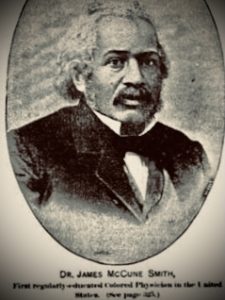
James McCune Smith is one of those people.

Born on April 18, 1813 to an enslaved mother in New York City, he was enslaved from birth and freed along with the rest of New York’s remaining slaves by the state’s Emancipation Act in 1827. 

 Very early in his life, Smith was identified as a gifted student while studying at the New York African Free-School. 

Even though he was academically gifted… 

Several American universities rejected him when he applied for admission because of his blackness.

Meanwhile, in Scotland, the University of Glasgow stepped in and offered him a place, which he accepted.

In recognition of Smith’s academic ability, they raised money to cover his passage to Scotland, tuition, and living expenses. 

In 1832-33, he took Greek classes, Anatomy classes in 1833-34, and Medicine and Surgery classes in 1835.

As a student at one of Britain’s “ancient” medieval universities and in the seat of the Scottish Enlightenment, Smith had access to a stimulating academic environment. 

While at Glasgow University, Smith earned three degrees with five years of study. 

  •  In 1835, he earned a Bachelor’s degree 
  • Followed by a Master’s degree in 1836
  •  Then a Doctorate of Medicine in 1837. 

In addition…

He was fluent in Latin, Greek, and French and with a working knowledge of Hebrew, Italian, Spanish and German. 

During the year 1837…

James McCune Smith graduated from the University of Glasgow as the first African American to receive a medical degree.

The man who returned to New York in 1837 had not simply been a gifted and able African American but was also a man who believed that things could be different. 

For an African American studying in Scotland, the opportunity to do so was unheard of in his own country, where slavery was still legal in the Southern states. 

But Smith believed that this could change. 

He believed he was living proof that things could be different – proving he was the same as any man, regardless of race. 

It was a belief he championed for the rest of his life. 

In recognition of the importance of his friend’s five years abroad, Frederick Douglass, the American social reformer and abolitionist, said: 

With his education in Scotland, he returned home with a vision of liberty …more so than those citizens of his city who were of African descent. “

As of the beginning of 1838…

 Dr. Smith opened the first African-American-owned and operated pharmacy in New York City; the pharmacy served black and white patients alike.

 Over the next 25 years, Dr. Smith would own two pharmacies and practice medicine. 

And so…

Dr. Smith’s body of work, including his abolitionist speeches and writings, supported an end to slavery.

Besides writing about medicine, science, pharmacy, literature, and geography, he was also an educator and an abolitionist.

 Regardless of his race, he was one of the foremost intellectuals in 19th century America. (Black American)

 Although he was interested in the professional world, he stepped beyond it to write about the people and the world around him; 

His work included a series of literary portraits of African Americans in New York City. 

Then…Read More

 In the 1840s, Smith married Malvina Barnet and had 11 children, but only five survived adulthood. Dr. Smith died of heart failure in November 17, 1865 at 52.

Black history is American history.

Black History Month …a time to commemorate!

While Black History Month is a time to commemorate what has been accomplished, it is equally important to recognize what needs to be done. 

African Americans have made significant contributions in every field, from science and technology to politics, sports, and history. 

Some of the incredible black Americans who helped shape our country and our world are listed here.

Debi Thomas 

She was born in 1967 in Poughkeepsie, New York.

Throughout her childhood, she dreamed of becoming a doctor. 

 As an engineering major, she worked toward what has always been her dream: to become an orthopedic surgeon.

She won two national championships at Stanford and a world figure skating title in her first year.

Figure skating titles

Also, as a Stanford pre-med student, 

  • Thomas won the 1986 U.S. National and World Figure Skating titles, 
  • Becoming the first and only African American to hold those titles.
  • Her achievement earned her a place in the U.S. Figure Skating Hall of Fame in 2000

Winter Olympics…

To train for the 1988 Winter Olympics, she postponed school for a year.

Subsequently, in Calgary, she became the first Black athlete to win an Olympic medal skating to the music of Bizet. 

 As a figure skater and a surgeon, she is active in her community.

Reference:

CNN/Sports Illustrated.

Samuel Milton Nabrit

A Black biologist, educator, and activist were born in Augusta, GA, to Rev. Dr. J.M. Nabrit Sr., and Gertrude West Nabrit. 

He was one of eight children who received a college education; his brother James Nabrit became president of Howard University

Education…

Nabrit attended schools in Macon and received his bachelor’s degree in biology from Morehouse College in 1925.

 In 1928, he received a Master’s degree from Brown University, and in 1932 he got a doctorate in biology from Brown University. 

Expertise 

A few years after becoming dean of Atlanta University’s graduate school of arts and sciences in 1947, he became chairman of its biology department in 1932. 

He was a founding member of the National Academy of Sciences’ Institute of Medicine and served as president of the National Institute of Science.

 The year 1950 was… 

Dr. Nabrit was a research fellow at the University of Brussels. 

The scientific papers Nabrit published during this period remained influential for decades. 

As of 1955…

As Texas Southern University’s second president, he served until 1966.

From 1956 to 1962… 

President Dwight D. Eisenhower appointed Dr. Nabrit to the National Science Board.

In 1966

President Lyndon B. Johnson appointed Dr. Nabrit to the United States Atomic Energy Commission. 

He founded the Southern Fellowship Fund to assist African American students pursuing doctoral degrees one year later. 

Dr. Nabrit joined Brown University’s Board of Trustees in 1967. 

In 1985…

Brown University established the Nabrit Black Graduate Student Association in his honor.

 From 1967 to 1981…

 Dr. Nabrit was chairman of the Atlanta-based Southern Fellowship Fund, which provided grants of $4 million to minority faculty members.

Lastly, Debi Thomas and Samuel Nabrit left their marks on American history by emphasizing Black history.

Reference:

Wikimedia Foundation

204 37th Avenue North Suite330

St. Petersburg, FL. 33704

Black history is American history.

Black history Since Black History Month is here, I wanted to share something that I believe is significant.

Black history is American history. It’s the story of how Africans and their descendants fought and sacrificed for this country, even when they weren’t given the same rights and opportunities as other citizens.

That’s what I want to talk about. 

Contrary to popular belief, black history is not just a celebration of Martin Luther King Jr., Rosa Parks, and Harriet Tubman. 

It’s so much more than that.

To me, black history is an ongoing journey – a never-ending struggle for liberty and justice. And it’s something that we should all be proud of. 

So let’s take a closer look at this critical part of American history – and learn why it matters today more than ever before.

 We must look at the role of black history in our society. Too often, black history is relegated to a single month out of the year, and its impact is minimized. 

There’s so much more to it than that! I’ll be sharing some of my favorite underrated black historical figures. 

These people have made significant contributions to society but don’t get as much recognition as they deserve. Stay tuned for my top five picks!

Shirley Chisholm (1924 – 2005)

There is more diversity in Congress now than ever before. But, the same could not be said about Chisholm’s attempt to break the glass ceiling. 

During the racial tensions of the late ’60s, she became the first Black woman elected to Congress to represent New York’s 12th District from 1969 to 1983.

 Most importantly, in 1972, she became the first woman and person of color to run for the Democratic Party’s presidential nomination. 

Her campaign slogan: “Unbought and Unbossed,” rings even louder today. 

Bayard Rustin (1912 – 1987)

While Dr. King is usually credited for the March on Washington in August 1963, Bayard Rustin organized and strategized in the background. 

He was viewed as a liability because he was gay and closely associated with communism. 

Despite that, he was one of the brightest minds around. He served his community tirelessly, a tireless advocate for better wages and jobs.

Claudette Colvin (1939 – )

In 1955, Rosa Parks was not the first female to refuse to give up her seat on the bus in Montgomery, Alabama, and was subsequently arrested.

 A courageous 15-year-old refused to give up her seat to a white woman on the bus and refused to move to the back of the bus before Rosa Parks.

 Her name was Claudette Colvin.

 She argued it was her constitutional right to remain seated near the middle of the bus and was subsequently arrested when she challenged the driver. 

She was the first woman to be detained for her resistance. However, her story isn’t nearly as well-known as Parks’.

Annie Lee Cooper (1910 – 2010)

 Ms. Cooper…a Selma, Alabama native, played a crucial part in the 1965 Selma Voting Rights Movement.

 They praise her for punching Alabama Sheriff Jim Clark in the face. 

 She deserves to be celebrated for fighting to restore and protect voting rights.

Following the 2016 election, the fight for voting rights remains as critical as ever. Politicians across the country continue to engage in voter suppression. 

Jane Bolin (1908 – 2007)

Jane Bolin was the first Black woman to attend Yale Law School in 1931. In 1939, she became the first Black female judge in the United States, where she served for 10 years.

 Her significant contribution throughout her career was working with private employers to hire people based on their skills instead of discriminating against them based on race. 

Marsha P. Johnson (1945 – 1992)

Marsha Johnson was a Black trans woman and leading advocate for the LGBTQ movement. 

Besides founding STAR, a homeless youth housing organization, Johnson was also a member of the Gay Liberation Front.

Rose Marie McCoy (1922 – 2015)

Although she couldn’t make her own voice heard in an industry dominated by white males, Rose McCoy could make her mark through her pen. 

In the 1950s, McCoy wrote and produced some of the biggest pop songs

Despite the failure of “After All” and “Gabbin’ Blues” to chart at all, music labels contacted her to write for others, including hit singles for Big Maybelle, Elvis Presley, and Big Joe Turner. 

You will now remember the name of the African American woman who wrote Presley’s song “Trying to Get You” now that you know its author.

Every day, we honor America’s past. But what about the present? What does America look like right now?

 It’s a reminder that every person has a unique and powerful story to tell. We are all connected by our shared experience as Americans. 

This Black History Month, learn more about the phenomenal individuals who helped shape our nation. 

What you discover may surprise you!

Finally, don’t forget to come back for more stories about people who played a significant role in this country’s defining moments.

https://jusmeetwo.com/african-american-history-facts/https://jusmeetwo.com/african-american-history-facts/