
Month: February 2022

A HAUNTING Voice From the Past…Fountain Hughes

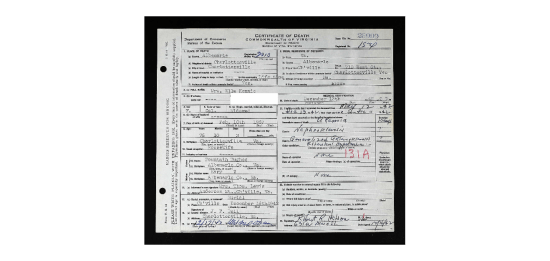
fountain hughes death certficate
fh1
fh2
fh3
fh4
fh5
 

Hey Folks! This blog post is for you. I hope you’re having a great day and are ready to learn something about and listen to the voices of African American men who worked to build this country up and have never been shown any appreciation.

 Throughout history, thousands of men and women desire to be talked about and shown some acknowledgment. People like Martin Luther King Jr., Rosa Parks, and Barack Obama have been written about and talked about for some time now.

However, You will not know these names, but this post will educate you on our black men who are worthy of being the topics of discussion. It is a painful history and matter; nonetheless, it is my topic today.

 I hope that this blog will enlighten you as well as be entertaining. 

The first person I will showcase is :

FOUNTAIN HUGHESFountain Hughes, Age 101

Fountain Hughes, circa 1952. Photograph courtesy of The Jeffersonian newspaper, Towson, Maryland.

Subsequently, Fountain Hughes lived a long time after gaining his freedom after the Civil War. According to the Census Reports, Mr. Hughes was 71 years old and married, living in Baltimore, Maryland, in the 1920 census.

And then, in the 1930 census, he was 81 years old, living at 3201 Wyler Ave, Baltimore, MD; 1940 census, he was 91 years 0ld and working as a Gardner. His workweek was 40 hours, and he earned $400.00 a month.

In any case, Fountain Hughes died at the age of 109 years old in 1957. The obituary was dated July 5, 1957. He was born in Charlottesville, Virginia.

He left behind a daughter named Shallie Addison.

Fountain Hughes, Interview.

“You wasn’t no more than a dog to some of them in them days. You wasn’t treated as good as they treat dogs now. But still I didn’t like to talk about it. Because it makes, makes people feel bad you know. Uh, I, I could say a whole lot I don’t like to . And I won’t say a whole lot more.”

Listen to the rest of the narrative…


I want to say thanks so much for reading my blog post intro paragraph today.

Thanks again, and stay tuned because I’ll be talking about more African American history next week! Make sure to keep following my blog posts if you’re interested in learning more about these topics!


Source of Information:

Ancestry.Com census records

Library of Congress

Chicago citation style:

Norwood, Hermond, and Fountain Hughes. Interview with Fountain Hughes, Baltimore, Maryland. Baltimore, Maryland, November , 6, 1949. Pdf. https://www.loc.gov/item/afc1950037_afs09990a/.

APA citation style:

Norwood, H. & Hughes, F. (1949) Interview with Fountain Hughes, Baltimore, Maryland. Baltimore, Maryland, November , 6. [Pdf] Retrieved from the Library of Congress, https://www.loc.gov/item/afc1950037_afs09990a/.


Sojouner Truth

Sojourner Truth…Is What They Call Her 2

Sojourner Truth 


They called her Sojourner Truth, but in actuality, her name was Isabella Baumfree. She was born in 1797 in Ulster County, New York, to James and Elizabethan Baumfree.

Along with her parents, she spent her life on the Johannesburg estate as a slave.

Sojouner Truth

Dutch was her first language since Dutch people enslaved her.

Despite everything, when she turned nine years old, she was sold away from her family to a man near Kingston, New York, named John Neely; He purchased her and some sheep for one hundred dollars.

For the most part, Sojourner was held by John Neely’s until 1808;

then, he sold her to Martinus Schryver of Port Ewen, New York, where she stayed for only 18 months.

Next, she was sold again to John Dumont of West Park, New York. There she remained his property until 1826. As a result of being sold over and over, she decided to escape.

All the more reasons to escape while at the Dumonts, Sojourner was not liked by John Dumont’s wife Elizabeth, experienced tension and harassment from her, and was raped by John.

What is more, through all of the turmoil, Sojourner met and fell in love with an enslaved man named Robert from a neighboring farm in 1815. Simply put, Robert’s owner beat him to death for meeting her against his wishes.

Sojourner Truth…It was Frightening and Horrific.

Sojourner had the pleasure of meeting another enslaved man named Thomas Years later, she had three children, Peter, Elizabeth, and Sophia, with Thomas.

Besides, before Thomas – her first child, James, died as a child. Her second, Diana, was the child of rape by John Dumont.

Shameful…they were still enslaved until adulthood. That law was useless.

That said, New York State passed a law for the gradual abolition of slavery. After July 4, 1799, children born to enslaved women were, by legal definition, free but required to work for their mother’s owner until they were in their twenties (28 for males and 25 for females).

Meanwhile, according to the law, those born before July 4, 1799, were considered indentured servants. The Truth is, in reality, they continued to be enslaved for life.

John Dumont promised to free Sojourner before the final emancipation date of the 1817 law in which all slaves in the State born before July 4, 1799 would become free on July 4, 1827.

Nonetheless, in 1826, before the date, Dumont had a change of mind. To that end, Sojourner freed herself by running away with her infant daughter Sophia.

She would later work to emancipate Peter after Dumont sold him to someone in Alabama in defiance of the law. Read More

Meanwhile, Isaac and Maria Van Wagenen’s in New Paltz, New York, gave Sojourner and Sophia refuge in their home and paid Dumont $20 for her labor until the emancipation day, July 4, 1827.

Straightaway, while staying with the Van Wagenen’s, Sojourner focused her attention on finding her son Peter; with her hosts’ assistance, she filed a court case for a legal hearing to get her son back to New York.

Amazingly, in 1828 the court ruled in her favor for Peter to get him back home to New York. Afterward, in 1829, she and Peter left New Paltz and moved to New York City.

There, Sojourner found a job as a housekeeper, but once again, there was trouble. She was accused of poisoning and stealing from her employers.

In due time she was acquitted of both charges.

Finally, in 1843, Sojourner became a Methodist, called by God, left the city and “testified across the countryside spreading her Truth; took the name Sojourner Truth; touring the country, speaking against slavery.

In 1844, she moved to Northampton, Massachusetts, joined the Northampton Association of Education and Industry, and wrote a book, named The Narrative of Sojourner Truth: a Northern Slave, which Garrison published.

Eventually, she bought a house in Northampton. She paid off her home three years later by selling photographs of herself captioned, “I sell the shadow to support the substance.”

At the Ohio Women’s Rights Convention held in Akron,
in May 1851, she spoke “Ain’t I a Woman?”, one of the most famous lessons on African American and women’s rights.

Sojourner Truth travels the United States speaking on matters relating to African Americans and women’s rights and the right to vote.

During the Civil War, Sojourner recruited African American men for the Union Army.

In 1864, while working at the National Freedmen’s Relief Association in Washington, D.C., she met President Abraham Lincoln; and rode on public streetcars in support of desegregation.

Soujourner Truth African Americans’ needs continued to travel and speak as her health declined. Sadly, She passed away in Battle, Michigan, at her home on November 26, 1883, at 86. She was laid to rest in Battle Creek’s Oak Hill Cemetery.

In her life, she tirelessly advocated for African Americans’ rights, women, and numerous reform causes, including prison reform and against capital punishment.

Source of Information
Sojourner Truth (U.S. National Park Service)


Thanks for Reading!